Show Summary
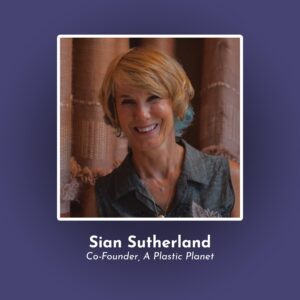
On this episode, Nate is joined by Sian Sutherland, a leader in the movement towards reducing the overconsumption of plastic and its waste. The modern era is dependent on fossil fuels for many reasons – one of the most covertly ubiquitous ones being plastic. Everyday we are surrounded by it – encasing our food, woven in the threads of our clothes, and even permeating into the water that we drink. How do we begin to break off this addiction to the convenience and utility of plastics? How does this connect to the larger implications of a society embedded in a linear, consumption-based system dependent on growth? What role can industry, governments, and individuals each play in creating structural shifts to reduce our reliance on plastic – and ultimately return to a slower, more circular way of life?
About Sian Sutherland
Sian Sutherland is Co-founder of A Plastic Planet, one of the most recognised and respected organizations tackling the plastic crisis. More recently, she also co-founded PlasticFree, the first materials and systems solutions platform, empowering the 160m global creatives to design waste out at the source. Sian was awarded the Female Marketer of the Year, Entrepreneur of the Year, and British Inventor of the Year. In 2023 at the UN Plastics Treaty negotiations (INC2), in partnership with Plastic Soup Foundation, A Plastic Planet launched the Plastic Health Council, bringing expert scientists to the negotiating process with the irrefutable proof of plastic chemicals impact on human health. Passionately pro-business and solutions focused, Sian believes the plastic crisis gives mankind a rare gateway to change both materials and systems to create a different future for next generations.
In French, we have a motto that says that a simple drawing is often better than a long explanation. Jean-Marc Jancovici Carbone 4 President
That’s very understandable because with left atmosphere thinking, one of the problems is that you see everything as a series of problems that must have solutions. Iain McGilchrist Neuroscientist and Philosopher
We can’t have hundreds and hundreds of real relationships that are healthy because that requires time and effort and full attention and awareness of being in real relationship and conversation with the other human. Nate Hagens Director of ISEOF
This is the crux of the whole problem. Individual parts of nature are more valuable than the biocomplexity of nature. Thomas Crowther Founder Restor
Show Notes & Links to Learn More
Download transcript00:35 – Sian Sutherland, A Plastic Planet, Plastic Free
05:13 – Blue Planet II, David Attenborough
09:55 – TGS Episodes on Plastic: Shanna Swan, Martin Scheringer
10:38 – Toxicity of plastics
10:57 – 13,000 chemicals are used to make plastic
12:01 – We consume a credit cards worth of plastic each week
12:08 – Plastic found in placenta, twice as much plastic in baby poop than adult poop
12:16 – Plastic in blood
13:09 – Endocrine disrupting chemicals
14:40 – Destruction of soil
15:55 – How quickly we create new chemicals
20:20 – Plastic never disappears, only degrades into smaller pieces
20:55 – How we use plastic
21:20 – Dopamine
21:29 – Minimalism Documentary
22:50 – Fast fashion
23:52 – Plastics in clothing
24:33 – Technical clothing made from natural fibers
26:38 – King Charles long-lasting clothes and shoes
28:35 – Marie Kondo
29:11 – You are the sum part of the 5 people you spend the most time with
29:40 – Recycling is not really a solution to plastic consumption
30:20 – Aluminum is infinitely recyclable, and glass and paper are good for recycling
30:40 – Plastic can only be recycled once or twice
31:55 – 5% of plastic in the US is recycled
32:12 – Wealthy nations export their plastic waste
32:56 – Resource materialism
33:03 – Waste Imperialism
34:18 – [40%] of UK waste exports go to Turkey
34:59 – Atacama Desert, Clothing pollution
35:29 – Ghana town that receives 15 million items of discarded clothing per week
39:22 – 1 trillion plastic sachets are produced every year
48:55 – France mandate the 20% of grocery store space be dedicated to refill
51:26 – 160 million creatives globally
54:35 – Plastic and healthcare
55:04 – 40% of plastic is used for packaging