Great simplification pulsing lines

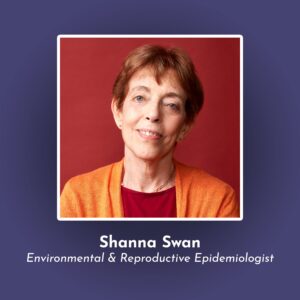
Ep 2  |  Dr. Shanna Swan

Dr. Shanna Swan “Sperm and Our Future”

Check out this podcast

TGS02 Shanna Swan Cover The Great Simplification

On this episode we meet with one of the world’s leading environmental and reproductive epidemiologists, Dr. Shanna Swan.

Dr. Swan discusses how chemicals in our environment threaten human hormones, male sperm count,  and ultimately, human reproduction. How do endocrine-disrupting hormones disrupt pregnancy? Further, she explains “The 1% Effect,” which accounts for the 1 percent annual decrease in human fertility and related functions.

To combat the urgent threats facing human reproduction, Dr. Swan offers recommendations about how we can avoid harmful chemicals — and live healthier lives.

About Shanna Swan

Shanna H. Swan, Ph.D., is one of the world’s leading environmental and reproductive epidemiologists. She is Professor of Environmental Medicine and Public Health at the Icahn School of Medicine at Mount Sinai in New York City where is also a member of the Transdisciplinary Center on Early Environmental Exposures and the Mindich Child Health and Development Institute.

In French, we have a motto that says that a simple drawing is often better than a long explanation. Jean-Marc Jancovici Carbone 4 President

That’s very understandable because with left atmosphere thinking, one of the problems is that you see everything as a series of problems that must have solutions. Iain McGilchrist Neuroscientist and Philosopher

We can’t have hundreds and hundreds of real relationships that are healthy because that requires time and effort and full attention and awareness of being in real relationship and conversation with the other human. Nate Hagens Director of ISEOF

This is the crux of the whole problem. Individual parts of nature are more valuable than the biocomplexity of nature. Thomas Crowther Founder Restor

Show Notes & Links to Learn More

Download transcript

00:50 – Shanna Swan website, Countdown: How Our Modern World Is Threatening Sperm Counts, Altering Male and Female Reproductive Development, and Imperiling the Future of the Human Race

03:17 – Endocrine disruptors – what are they, what are effects

04:55 – Study showing 47 million/milliliter sperm count in US and 50% decline over last 50 years

07:54 – Number of babies being born per woman dropped by 50%

09:07 – Insect biomass declining by one percent per year = gone in whatever time frame

09:55 – Endocrine system

11:30 – In-utero disruption vs adult disruption

12:38 – Cumulative generational exposure

13:46 – Smoking known to be cancerous in 1964

14:40 – Discomfort with talk about reproductive function

14:45 – Reproduction doesn’t have an NIH center

16:00 – The Graduate line

16:17 – FDA and EPA study of toxic impacts from chemicals, studying high vs low doses

18:25 – Amenorrhea

19:30 – Phthalates individual vs collective effects

20:57 – Phthalates affect size of genitals

22:38 – What are phthalates in?

22:56 – Toxic chemicals in Mariana Trench

23:12 – Endocrine disruptors on arctic ice

23:16 – Ant colonies in the amazon have phthalate exposure

24:08 – 22 new species are extinct

24:17 – FWS criteria for endangerment/list

24:39 – Drivers for endangerment

24:49 – Shrinking penis sizes of alligators in Lake Apopka

25:35 – Tyrone Hayes, Atrazine

26:45 – Endocrine disruptors and domesticated species

27:46 – How plastic is made, convenience

28:02 – How a barrel of oil is used, all of the areas of demand

29:07 – How to make plastic out of other sources

30:45 – Processing of food chemical introduction (eastern Europe cow milk study)

32:05 – Million marker endocrine disruptor testing 

33:20 – Half life of phthalate 4-6 hours

33:32 – Cleanup reproductive health in 3 generations

35:17 – Denmark infertility program

35:40 – Do it for Denmark Campaign

35:50 – Economic systems require babies

36:48 – 2.1 replacement reproductive level

36:55 – Most developed countries below replacement rate of 2

37:52 – Children of Men

38:18 – Assisted reproduction

38:27 – Israel’s program for assisted reproduction

40:07 – Half of men on the East coast have Ghengis Khan’s Y chromosome

Back to episodes
If Anyone Builds It, Everyone DiesWith Nate SoaresThe Great SimplificationEp 203 | Nate Soares

Technological development has always been a double-edged sword for humanity: the printing press increased the spread of misinformation, cars disrupted the fabric of our cities, and social media has made us increasingly polarized and lonely. But it has not been since the invention of the nuclear bomb that technology has presented such a severe existential risk to humanity – until now, with the possibility of Artificial Super Intelligence (ASI) on the horizon. Were ASI to come to fruition, it would be so powerful that it would outcompete human beings in everything – from scientific discovery to strategic warfare. What might happen to our species if we reach this point of singularity, and how can we steer away from the worst outcomes?

Watch nowDec 3, 2025
Reimagining Ourselves at the End of the WorldWith Samantha SweetwaterThe Great SimplificationEp 202 | Samantha Sweetwater

Over the past decade, the world has become increasingly chaotic and uncertain – and so, too, has our cultural vision for the future. While the events we face now may feel unprecedented, they are rooted in much deeper patterns, which humanity has been playing out for millennia. If we take the time to understand past trends, we can also employ practices and philosophies that might counteract them –  such as focusing on kinship, intimacy, and resilience – to help pave the way for a better future. How might we nurture the foundations of a different kind of society, even while the end of our current civilization plays out around us?

Watch nowNov 24, 2025
Two Ways of KnowingWith Rosa Vásquez EspinozaThe Great SimplificationEp 201 | Rosa Vásquez Espinoza

For centuries, modern science has relied on the scientific method to better understand the world around us. While helpful in many contexts, the scientific method is also objective, controlled, and reductionist – often breaking down complex systems into smaller parts for analysis and isolating subjects to test hypotheses. In contrast, indigenous wisdom is deeply contextual, rooted in lived experience, and emphasizes a reciprocal, integrated relationship with the rest of the natural world, viewing all parts of the system as interconnected. What becomes possible when we combine the strengths of each of these knowledge systems as we navigate humanity’s biggest challenges? 

Watch nowNov 19, 2025

Subscribe to our Substack

The Institute for the Study of Energy and Our Future (ISEOF) is a 501(c)(3) non-profit corporation, founded in 2008, that conducts research and educates the public about energy issues and their impact on society.

Support our work
Get in touch
x